Credential Holder Spotlight: Miranda Y. Pearson
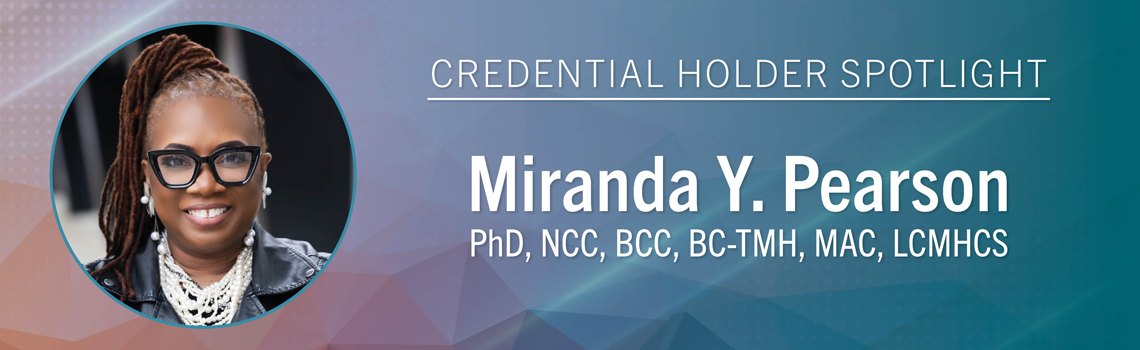
After beginning her career as a high school teacher in 1996, Miranda Y. Pearson, PhD, NCC, BCC, BC-TMH, MAC, LCMHCS, transitioned into working as a School Counselor and district administrator. She had always enjoyed helping others, and her experience in education eventually led to a multifaceted career in human services.
“I discovered that students were struggling not only academically, but also emotionally and psychologically,” Dr. Pearson recalls. “That realization shifted my trajectory, and I came to understand that addressing mental and emotional health was foundational to every other form of success. Counseling was not merely a career choice; it became a calling.”
Today, Dr. Pearson is the Clinical Director of Divine Appointment Counseling Services, PA, in North Carolina and the Founder of the PhD Trauma Institute, Inc. She is also an Adjunct Professor for Webster University, a clinical supervisor, an ordained minister, an executive coach, and a published author.
“My current work centers on trauma-informed clinical practice, supervision of associate-level Counselors, leadership development for faith leaders, and executive coaching for high-capacity professionals,” she says. “I operate at the intersection of mental health, faith, and leadership, helping individuals heal, grow, and perform at their highest level, both personally and professionally.”
After becoming a Professional Counselor, Dr. Pearson also developed an interest in coaching.
“I noticed a clear need among high-functioning professionals who were not clinically impaired but required strategic clarity, accountability, and executive-level support,” she recalls. “Coaching complements Counseling but serves a different purpose. Coaching focuses on optimization, alignment, and forward movement rather than clinical treatment.”
She was excited to discover CCE’s Board Certified Coach (BCC) credential and earned the certification in 2012.
“The BCC credential formalized my coaching competencies and aligned my work with nationally recognized standards,” she says. “As a licensed clinician, I value structured frameworks, ethical accountability, and professional credibility. Earning the BCC allowed me to expand my service model while maintaining clear role distinctions between therapy and coaching. It strengthened my professional portfolio and signaled to clients and organizations that my coaching is evidence-informed and credentialed.”
Dr. Pearson says earning the BCC has given her a professional advantage and led to new opportunities and experiences.
“It has allowed me to expand into executive and leadership coaching spaces, contract with organizations that require credentialed coaches, distinguish my services clearly between clinical therapy and performance coaching, and increase professional credibility within interdisciplinary circles,” she says, adding that the BCC has also enhanced her marketability and clarity of scope.
She is careful to emphasize the differences between counseling and coaching to her clients and the ethical imperative to provide these services entirely separately and for different individuals.
“I explain it in terms of focus and function,” Dr. Pearson says. “Counseling addresses diagnosis, trauma history, emotional regulation, and psychological healing. It is clinically driven and may include treatment planning and insurance billing. Coaching, on the other hand, centers on goals, leadership development, performance optimization, and accountability. It does not address mental health disorders. I am clear about the scope of practice. If a client presents with clinical symptoms requiring therapeutic intervention, counseling is appropriate. If the client is stable and seeking strategic advancement, coaching is appropriate. Clarity protects both the client and the practitioner alike.”
She offers some additional advice for others considering the BCC credential.
“Pursue it thoughtfully and strategically. Coaching is not therapy-lite; it is a distinct discipline with its own competencies and ethical standards. The BCC provides structure, credibility, and national recognition. For licensed professionals seeking leadership, executive, or performance-development roles, this credential is valuable; however, practitioners must remain vigilant about the scope of practice and dual-role boundaries. Ethical clarity is non-negotiable.”
Though each of her professional roles has its own merits, they all focus on what Dr. Pearson enjoys most—helping others live their best lives.
“I enjoy transformation,” she says. “There is nothing more rewarding than witnessing a client, supervisee, or leader move from confusion to clarity, from burnout to renewal, and from pain to purpose.”
Miranda Y. Pearson, PhD, NCC, BCC, BC-TMH, MAC, LCMHCS, is a National Certified Counselor, Board Certified Coach, Board Certified-TeleMental Health Provider, Master Addictions Counselor, and Licensed Clinical Mental Health Counselor Supervisor. She is also a Professor, speaker, ordained minister, and thought leader committed to advancing community mental wellness.
**Opinions and thoughts expressed in CCE Connections Newsletter articles belong to the interviewees and do not necessarily reflect the opinions or practices of NBCC and Affiliates.
Share On Social Media:
Read more articles